
Medicare Insurance Agent in Winnebago County, IL

A good Medicare insurance agent in Winnebago County does three things for you: explains your options in plain language, compares real plans against your doctors and prescriptions, and stays with you after you enroll. At Almond Insurance, a family-oriented Medicare agency in Rockford, that is the job. You do not pay us directly for the advice. This guide covers what an agent can and cannot do under federal rules, how agents are paid, and what to ask before you sit down with anyone.
TL;DR
- A licensed agent can explain plan options, give you plan materials, and give and collect an enrollment form. Federal rules bar agents from charging an enrollment fee or steering you to one plan.
- Agents are paid by insurance carriers when you enroll, so the guidance itself does not come with a bill to you.
- Ask how many companies and plans the agent represents in your area. Medicare rules require agents to tell you before discussing benefits.
- The main window to change a Medicare Advantage or Part D plan runs October 15 to December 7, with changes effective January 1. Other windows apply at 65 and after certain life events.
- Bring your doctor list and every prescription to the first meeting. Those two lists decide which plan fits.
Table of Contents
- What a Medicare agent actually does for you
- How Medicare agents are paid
- The rules every agent in Illinois works under
- Comparing Advantage, Supplement and Part D with an agent
- Questions to ask before you choose an agent
- When to meet with an agent
- What to bring to your first meeting
- Working with Almond Insurance in Rockford
- FAQ
- Sources
What a Medicare agent actually does for you
Medicare has several moving parts. Original Medicare (Parts A and B) is run by the federal government. Private insurers sell Medicare Advantage (Part C), Medicare Supplement (Medigap) and Part D drug plans. Choosing among them is where most people get stuck, and it is where an agent earns their place.
Medicare.gov says that during a meeting, an agent or broker may give you plan materials, explain plan options, give and collect an enrollment form, and hand you a business card. In practice, a thorough agent does more than that:
- Sorts out where you are. Turning 65, retiring, moving, or losing employer coverage each opens different choices.
- Compares plans side by side. The National Association of Senior Advocates describes a proper comparison as covering benefits, premiums, out-of-pocket costs, prescriptions and provider networks, with your drugs checked against each plan’s formulary (its list of covered drugs).
- Checks your doctors and pharmacy. Medicare.gov advises confirming that your doctors and pharmacies are in network and reviewing premiums, deductibles and estimated yearly drug costs before you join.
- Handles the enrollment paperwork. A mistake on a form or a missed deadline can leave you without coverage you meant to have.
- Comes back every year. Plans change their costs, networks and drug lists each January. A yearly review catches this before it costs you.
That last point matters most for people who already have coverage. Many people enroll once and never look again. Our yearly Medicare coverage review checklist for Winnebago County walks through what to check.
How Medicare agents are paid
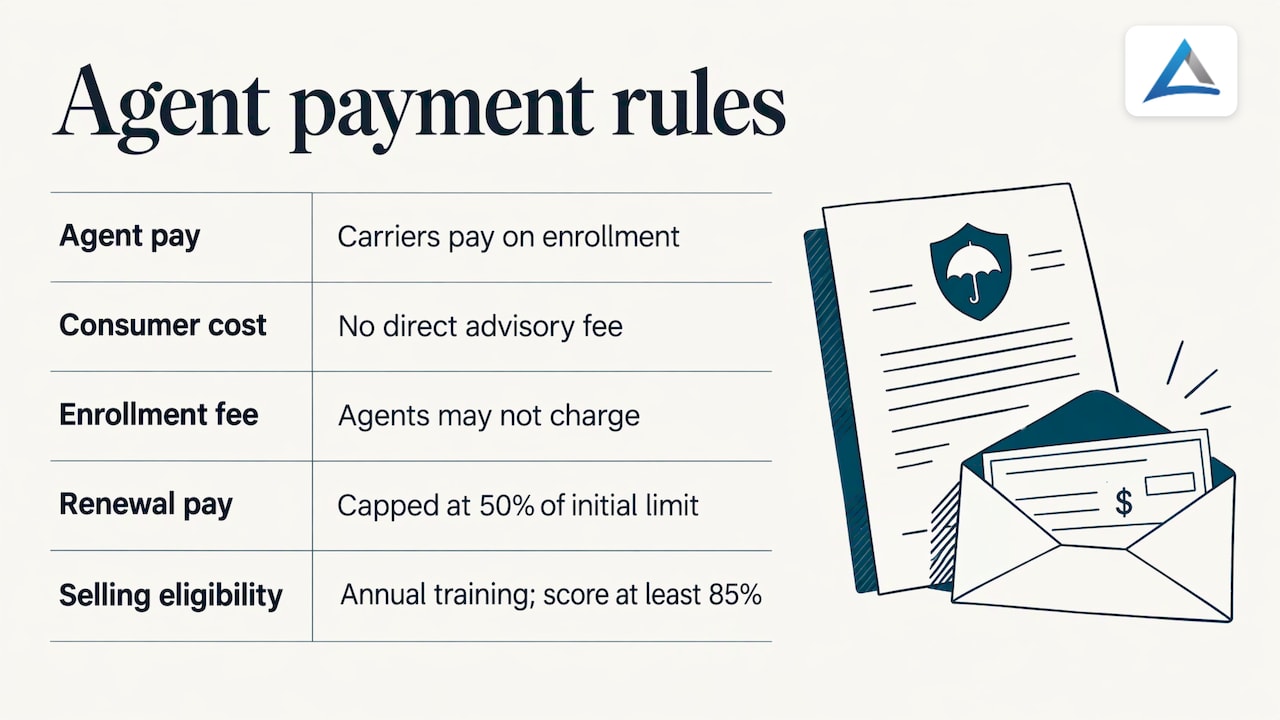
The question “Do Medicare insurance agents charge?” comes up constantly, and the answer is simple. Agents are paid by the insurance carriers, not by you. Almond Insurance is commission-based: a carrier pays us when you enroll in a plan through our guidance. Consumers do not pay directly for the advisory service, and caregivers or information-seekers who never enroll in a plan pay nothing.
Federal rules also limit what agents can collect from you. Medicare.gov states that agents may not charge an enrollment fee, steer you to a particular plan, pressure you, or ask you to sign before you are ready.
Carrier compensation is itself regulated. A 2026 training document for agents from a regional health plan explains that CMS (the Centers for Medicare & Medicaid Services) sets annual Fair Market Value limits on initial compensation, with renewal pay capped at 50% of that amount. The same document says agents must be trained and tested every year before they can sell, and must score at least 85% on the test to be eligible for compensation.
The rules every agent in Illinois works under
Knowing the rules lets you recognize a professional quickly.
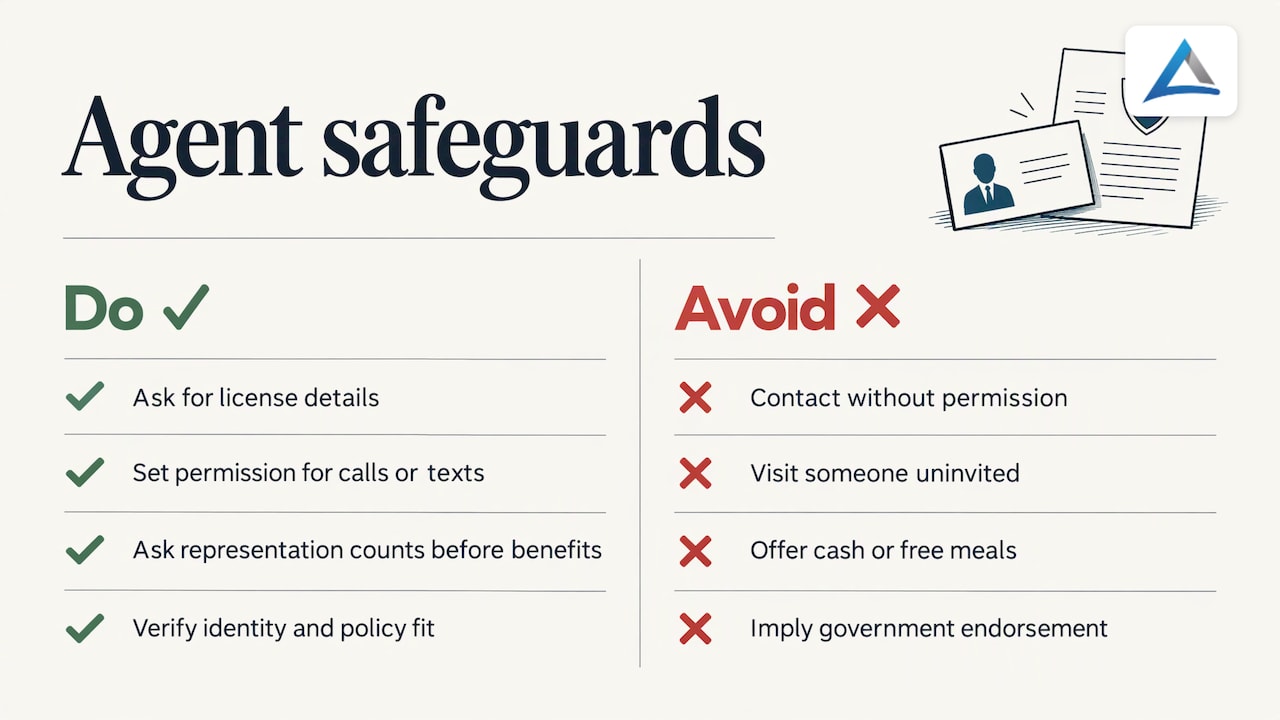
Licensing. Medicare.gov says independent agents and brokers must be licensed by your state, and that plans must tell the state which agents sell their products. Ask for the agent’s name and license details and keep the business card.
No uninvited contact. The same Medicare.gov page says plans and their agents may not come to your home uninvited, and may not call or text you unless you are already a member or gave permission. Gifts are limited: no cash, no free meals, and nothing worth more than $15 as an incentive to join.
Disclosure up front. Agents may only discuss products you agreed to hear about. Before they discuss benefits, they must tell you how many organizations they represent and how many plans they offer in your area.
Honest descriptions. Under the Illinois Insurance Code, 215 ILCS 5/363a, an agent making a home sale of a Medicare supplement policy must identify themselves as an insurance agent, name the insurers they are licensed for, give you their printed name, address and phone number, and determine that the policy is appropriate, suitable and not duplicative of coverage you already have. Agents also may not imply government endorsement, or use titles such as “Medicare consultant” or “Medicare advisor” to suggest their pay is unrelated to insurance sales. A related section prohibits misrepresenting the insurer, the coverage, the effective date, or your right to cancel within 30 days of receiving the policy.
If something goes wrong, the Illinois Department on Aging’s 2026 guide lists the Office of Consumer Health Insurance at 1-877-527-9431 for complaints and referrals, and 1-800-MEDICARE (1-800-633-4227) is open around the clock.
Comparing Advantage, Supplement and Part D with an agent
The core decision for most people in Winnebago County is Medicare Advantage or Medicare Supplement, plus a drug plan where needed. Here is how they differ at a glance.
| Medicare Advantage (Part C) | Medicare Supplement (Medigap) | |
|---|---|---|
| Who sells it | Private insurers approved by Medicare | Private insurers |
| How it works with Original Medicare | Replaces Parts A and B with one plan | Pays costs that Original Medicare leaves |
| Networks | Typically in-network providers | See Medicare.gov and your plan documents |
| Drug coverage | Often included | Separate Part D plan |
| Out-of-pocket limit | Annual limit set by the plan | Depends on the Medigap plan |
The Illinois Department on Aging’s 2026 guide explains that Advantage plans must cover Part A and Part B services, often include Part D, typically require in-network providers, set an annual out-of-pocket limit, and may charge a monthly premium on top of the Part B premium. That Part B premium was $202.90 a month as the standard amount for 2026, according to the Medicare & You 2027 handbook. People with higher incomes may pay an income-related adjustment: for 2026 that applied when 2024 income was above $109,000 for an individual or $218,000 for a married couple filing jointly.
The same Illinois guide cautions against basing the decision only on extras like vision, dental or gym memberships. That is where an agent helps: the extras are easy to see, while networks, drug tiers and out-of-pocket exposure take work to compare. Our pages on Medicare Advantage costs and Advantage versus Supplement go deeper.
Timing matters for Supplements. The NAOSA guide notes that in many states Medigap plans are medically underwritten outside certain windows, which can make it hard to move from Advantage to Medigap after you become ill. Better to understand that before you choose than after.
For drug coverage, a 2026 insurer training document states that once a Part D member’s true out-of-pocket spending reaches $2,100 in 2026, they pay nothing more for formulary drugs for the rest of the year. The figure is reset by CMS each year, so confirm the one for the plan year you are shopping. A prescription-by-prescription check is how you see what each plan would cost you.
Questions to ask before you choose an agent
You are not just choosing a plan. You are choosing the person you will call in March when a claim looks wrong. These questions separate a patient advisor from a fast sales pitch:
- Which companies and how many plans do you represent in my area? Medicare rules require the answer before benefits are discussed.
- Will you check my doctors, hospital and pharmacy against each plan? The answer should be yes, by name.
- Will you run my prescriptions through each plan’s drug list? Bring the full list, with doses.
- How do you explain trade-offs between plan types? The comparison of HMO and PPO differences shows why the network type shapes which doctors you can see and how easily.
- Do you review my coverage every year? Plans change each January, and your health changes too.
- Can I take time to decide? You should never be asked to sign before you are ready.
If an agent calls you unprompted, offers a gift, or rushes you, that conflicts with the Medicare marketing rules described above. You can end the conversation and call 1-800-MEDICARE.
When to meet with an agent
You can only join, switch or drop a Medicare Advantage or drug plan during an enrollment period. Medicare.gov lists the main ones:
- Initial Enrollment Period: seven months around your 65th birthday.
- Open Enrollment: October 15 to December 7, with changes effective January 1.
- Medicare Advantage Open Enrollment: January 1 to March 31 for people already in an Advantage plan.
- Special Enrollment Periods: certain life events, such as moving or qualifying for Extra Help.
The dates are on Medicare.gov’s joining a plan page, and the Illinois Department on Aging confirms the same October 15 to December 7 window. Plans send an Annual Notice of Change and Evidence of Coverage each year. Bring those letters to your review, because they show what is changing in your plan.
If you are approaching 65, start a few months early. Our Medicare enrollment timeline lays out the sequence, and the enrollment periods explained simply page covers each window. If you missed a window but had a life change, see Medicare Special Enrollment Periods.
What to bring to your first meeting
A first meeting goes faster and produces better answers when you arrive with:
- Your Medicare card, if you have it, and your Social Security number.
- A list of every doctor, specialist, hospital and pharmacy you use.
- Every prescription, with the dose and how often you take it.
- Your current plan’s most recent Annual Notice of Change, if you have a plan.
- Notes on anything that worries you: a planned surgery, a regular specialist visit, or travel.
Caregivers are welcome too. If you help a parent or spouse with Medicare, come along with their lists. Medicare questions are easier when two people hear the answers.
If your income and savings are modest, ask about help with costs. The Illinois Department on Aging’s 2026 guide states that the Medicare Savings Program applies to people with monthly income below $1,796 as an individual or $2,435 as a couple, and resources of $9,950 or less for an individual or $14,910 for a couple. Qualifying stops the Part B premium deduction from your Social Security check and enrolls you in Extra Help for Part D, and applications are made at abe.illinois.gov. See our Medicare Savings Program guide for Illinois for more.
Working with Almond Insurance in Rockford
Almond Insurance is a Medicare agency based in Rockford, serving Northern Illinois and Southern Wisconsin. We work with people new to Medicare, people reviewing the coverage they already have, and the caregivers who help them. Our approach is family-oriented and jargon-free: we explain each step, one conversation at a time, and we prioritize clarity over a sales-first process.
Here is what we offer:
- New-to-Medicare guidance for people turning 65 or retiring.
- Medicare Advantage and Supplement comparison.
- Part D prescription review.
- Annual coverage reviews, so your plan keeps matching your health.
- Enrollment support from first form to confirmation.

If you would like to talk through your options, see our Medicare services or the plans we help people choose. We also help residents across the state line; see our page for Beloit, Wisconsin.
FAQ
How do I find a local Medicare agent in Winnebago County?
Look for a licensed agent based in the Rockford area who will tell you how many companies and plans they represent before discussing benefits. Ask for a business card and license details, and choose someone who will also review your coverage every year. Almond Insurance is at 6870 Rote Rd, Suite 101, Rockford.
Do Medicare insurance agents charge consumers?
No. Federal rules say agents may not charge an enrollment fee. Agents are paid by the insurance carrier when you enroll in a plan, so you do not pay Almond Insurance directly for our guidance.
Can an agent pick a plan for me?
An agent explains your options, compares plans and helps with enrollment, but the choice is yours. Medicare rules bar agents from steering you to a particular plan or pressuring you to sign before you are ready.
When is the best time to review my Medicare plan?
The main change window is October 15 to December 7, with new coverage starting January 1. If you are already in an Advantage plan, there is also a window from January 1 to March 31. Life events such as a move can open a Special Enrollment Period.
Sources
- Marketing rules for Medicare health & drug plans, Medicare.gov
- Joining a plan, Medicare.gov
- Medicare & You 2027, Medicare.gov
- Medicare Choices Guide for 2026, Illinois Department on Aging
- Illinois Insurance Code, 215 ILCS 5/363a (home solicitation requirements)
- Illinois Insurance Code, 215 ILCS 5/363a (misrepresentation and cancellation)
- Medicare Supplement & Medicare Advantage Insurance, NAOSA
- 2026 Medicare Basics Training, MVP Health Care