
Medicare for Early Retirees: Bridging the Gap Until 65

If you retire before 65, Medicare does not start when you stop working. It starts at 65 for most people, so early retirement leaves you with a stretch of years in which you need other health coverage, followed by a Medicare sign-up with timing rules that are easy to miss. We help people in Northern Illinois and Southern Wisconsin plan both halves: what to do before 65, and how to land in the right Medicare plan the month you become eligible.
TL;DR
- Retiring at 62 or earlier, or claiming Social Security early, does not make you eligible for Medicare. For most people eligibility begins at 65.
- Before 65 you generally choose among retiree coverage, COBRA, a spouse’s plan or a Marketplace plan. Losing job-based coverage opens a Marketplace special enrollment period.
- Your Medicare Initial Enrollment Period is seven months, centered on your 65th-birthday month. Missing it can mean a lifelong Part B penalty.
- COBRA and retiree plans do not stop the Part B clock the way current employer coverage can.
- Choosing between Medicare Advantage, Medigap and Part D is easier when someone lays the options side by side with your doctors and prescriptions.
Table of Contents
- Why retiring early does not start Medicare
- Your options for coverage before 65
- When Medicare starts: your Initial Enrollment Period
- The trap early retirees fall into: COBRA and retiree coverage do not pause Part B
- What a late sign-up costs
- What if you have not claimed Social Security?
- Choosing your Medicare plan once you are eligible
- How we help early retirees
- A simple early-retiree timeline
- FAQ
- Sources
Why retiring early does not start Medicare
Medicare is tied to age, not to your work status. The Social Security Administration says the age for Medicare eligibility remains 65, even though the full retirement age for people turning 62 in 2026 is 67. Those are two different ages, and early retirees often mix them up.
That means claiming Social Security at 62 does not bring Medicare with it. It also means that if you retire at 60, you have roughly five years to cover on your own.
There are narrow exceptions. CMS says Medicare is also available to qualifying people with disabilities or End-Stage Renal Disease (permanent kidney failure). CMS’s July 2026 job aid lists the under-65 routes, including 24 months of qualifying disability benefits and ALS-related eligibility. If your early exit from work was because of a disability, see our guide to Medicare after disability. Everyone else waits for 65.
Your options for coverage before 65
The good news is that you have real choices. HealthCare.gov names Marketplace coverage, retiree coverage and COBRA as the main routes for people who stop working before 65. The Society of Actuaries adds Medicaid and veterans’ or military programs to the list. Here is how the common ones compare.
| Option | What it is | Key things to know |
|---|---|---|
| Retiree coverage from your former employer | A plan the employer offers to people who retire | If you actually enroll in it, you cannot get Marketplace income-based savings. Being eligible but not enrolled does not by itself bar those savings. |
| COBRA | Continuing your employer’s plan after you leave | Generally available for 18 months after a qualifying job loss, and you usually pay a higher premium than you did as an employee. |
| Spouse’s employer plan | Joining a working spouse’s coverage | Often the simplest bridge if your spouse is still working. |
| ACA Marketplace plan | An individual plan bought through the Marketplace | Losing job-based coverage qualifies you for a special enrollment period. An application checks eligibility for premium tax credits, lower out-of-pocket costs or Medicaid. |
| Medicaid, or veterans’ and military programs | Programs based on income or service | Eligibility depends on your income, household size or service record. |
Why the premium surprise happens
While you work, your employer typically pays most of your premium. The Society of Actuaries’ report, citing a 2019 employer benefits survey, puts the average employer subsidy at about 80% of single-coverage premiums and 70% of family coverage. At retirement that subsidy ends, and individual-market premiums are age-rated instead of averaged across a workplace group. So premiums often rise at retirement. Build that into your retirement budget before you give notice, not after.
Watch the special enrollment window
HealthCare.gov explains that losing job-based coverage qualifies you for a Marketplace special enrollment period. If your COBRA runs out, that also qualifies. Voluntarily dropping COBRA generally does not. So if you plan to use COBRA for a while and then move to the Marketplace, know that you cannot simply drop it on a whim and expect to enroll right away. Apply through HealthCare.gov or your state’s exchange to see what your income and household size qualify you for.
If you are comparing what different plan types pay for once you are sick or hospitalized, this overview of what Medicare Parts A, B and D pay for shows how the parts divide up care, which is useful context as you look ahead to 65.
When Medicare starts: your Initial Enrollment Period
Your first chance to sign up is the Initial Enrollment Period (IEP). Medicare.gov describes it as a seven-month window. It generally starts three months before the month you turn 65 and ends three months after it.
For an early retiree with no employer coverage, this is the window that matters. Treat the first day of your birthday month as the target. Signing up in the three months before it lets coverage begin without a gap, while waiting until the last months of the window can mean a delayed start. Our Medicare enrollment timeline lays the dates out month by month, and our explainer on Medicare enrollment periods covers the other windows you may meet later.
A worked example
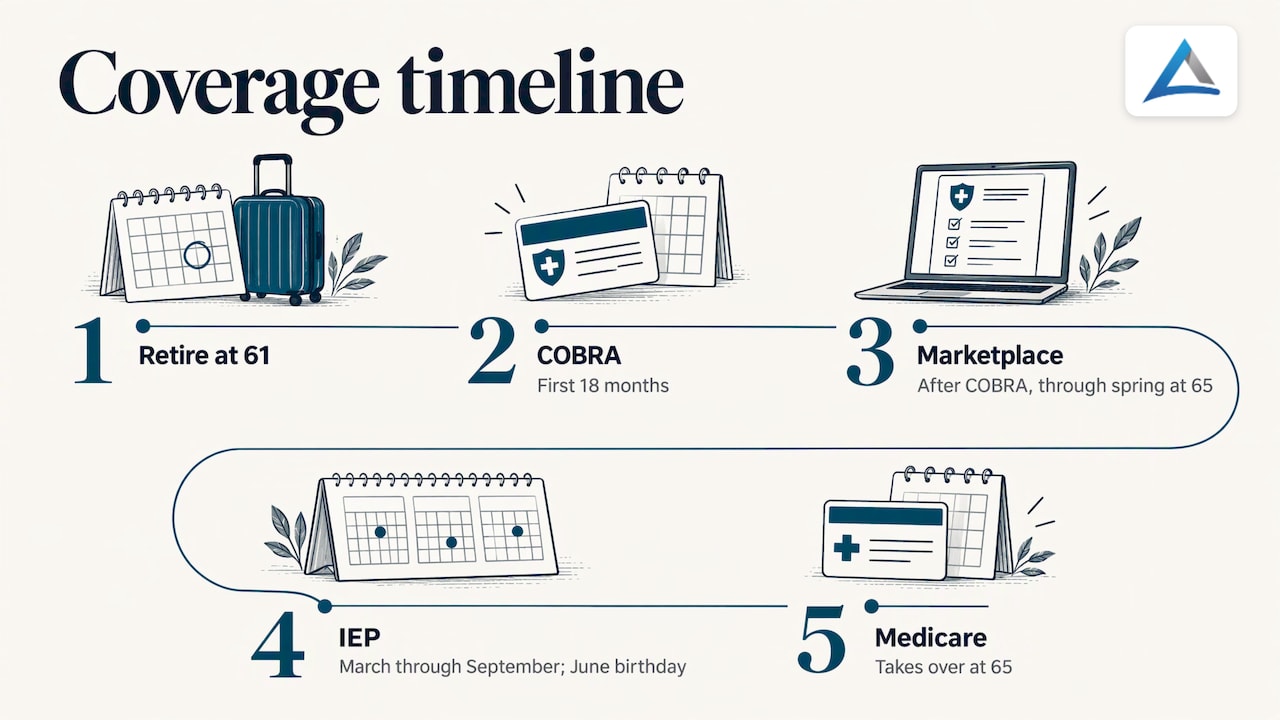
Say you retire at 61 and your 65th birthday is in June. Your IEP opens in March, includes June, and closes at the end of September. You spend the four years in between on a mix of COBRA for 18 months, then a Marketplace plan. In the spring of your 65th year, you stop the Marketplace plan, and Medicare takes over. You will want to line up the end date of the old plan with the start date of the new one, so there is no uncovered month. Marketplace savings stop being relevant once you are eligible for Medicare, so plan the changeover rather than letting the old plan simply lapse.
The trap early retirees fall into: COBRA and retiree coverage do not pause Part B
This is the mistake we most want you to avoid. People hear that you can delay Medicare if you have other coverage. That is true only for certain coverage, namely group health coverage based on current employment, yours or your spouse’s.
Medicare.gov says that with qualifying current-employment coverage you can use a Part B special enrollment period while covered or for up to eight months after the employment or coverage ends, whichever comes first. It also states that the eight-month period starts when you or your spouse stop working, even if you choose COBRA or other non-Medicare coverage. COBRA does not extend it.
For an early retiree this matters in two ways:
- If you are already 65 or older and retire from a job with group coverage, you have eight months from the end of that work to enroll in Part B. COBRA does not buy you more time.
- Retiree plans often expect you to have Medicare. Medicare.gov’s retiree guidance warns that you may need Parts A and B to receive full retiree-plan benefits, and that your time to enroll without a penalty is limited.
Our guides on COBRA versus Medicare, special enrollment periods and what to do with employer coverage walk through the common situations.
What a late sign-up costs
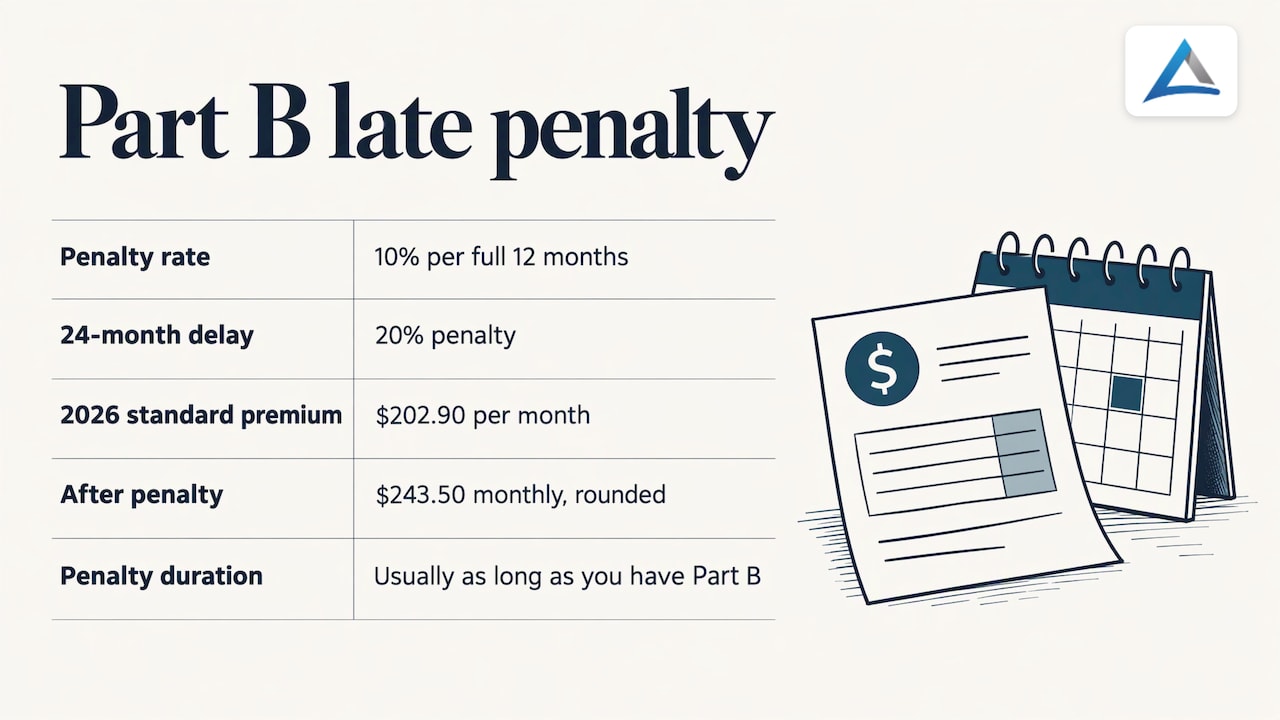
If you miss your window and have no special enrollment period, the penalty is permanent. According to the January 2026 Get Ready for Medicare booklet, the Part B late-enrollment penalty is 10% for each full 12-month period you could have had Part B but did not, and it usually lasts as long as you have Part B.
The same booklet gives the standard Part B premium as $202.90 per month for 2026. It illustrates that a 24-month delay produces a 20% penalty and a monthly premium of $243.50 after rounding. That premium is set each year, so check the current figure on Medicare.gov when you plan. For a deeper look, read our page on the Medicare late enrollment penalty. If you also have prescription coverage questions, our Part D penalty calculator can help you see how a gap in drug coverage adds up.
What if you have not claimed Social Security?
Many early retirees delay Social Security to get a larger check, and they worry that this blocks Medicare. It does not. You can enroll in Medicare at 65 whether or not you are collecting benefits. The process is a little different, since you will not be auto-enrolled, so read how to sign up for Medicare without Social Security. If you left a job to work for yourself, Medicare for the self-employed covers costs and taxes.
Choosing your Medicare plan once you are eligible
Original Medicare (Parts A and B) is only the start. Most people then choose one of two paths:
- Medicare Advantage (Part C): a plan that bundles hospital, medical and usually drug coverage.
- Medicare Supplement (Medigap) plus a Part D drug plan: coverage that works alongside Original Medicare.
The right choice depends on your doctors, your prescriptions, how much you travel and how you want to handle costs. Early retirees often have one extra consideration: you may be used to the plan you built through work, and you want a smooth handoff of doctors and medications. We compare these plans for people in Northern Illinois and Southern Wisconsin, and we explain them in plain language so the choice is clear.
How we help early retirees
We are a Medicare agency based in Rockford, Illinois, and we work with individuals and caregivers across Northern Illinois and Southern Wisconsin. For someone retiring early, the useful pieces are:
- New-to-Medicare guidance to map your enrollment window to your birthday and your current coverage.
- A Medicare Advantage and Supplement comparison built around your doctors and needs.
- A Part D prescription review so your medications are checked against plan drug lists.
- Enrollment support and an annual coverage review each year after you join.
Our approach is family-oriented and jargon-free, with patient, step-by-step education rather than a sales-first process. You do not pay us directly for the advisory service. We are compensated by the insurance carrier when you enroll in a plan through us.

If you are within a few years of 65, or a caregiver helping a parent who is, start with our services page, or go straight to the enrollment next steps. We also serve residents across the state line, including Beloit, Wisconsin.
A simple early-retiree timeline
- Two to three years before you retire: price your pre-65 options, including COBRA, a spouse’s plan and the Marketplace, so you know the real premium.
- At retirement: confirm whether you have retiree coverage and whether enrolling in it affects Marketplace savings. Note any special enrollment deadlines that start when coverage ends.
- About six months before 65: gather your doctor and prescription lists and start comparing Medicare plans.
- Three months before your birthday month: your Initial Enrollment Period opens. Enroll so coverage starts on time.
- Every autumn after that: review your plan for the following year, because plans and drug lists change.
FAQ
Can I retire at 62 and still get Medicare?
No. Retiring or claiming Social Security at 62 does not make you eligible. Medicare eligibility remains at 65 for most people, with exceptions for certain disabilities and End-Stage Renal Disease. Until 65 you need other coverage such as COBRA, retiree coverage, a spouse’s plan or a Marketplace plan.
What if I cannot afford health coverage before 65?
Apply through HealthCare.gov. The application uses your income and household size to check whether you qualify for premium tax credits, lower out-of-pocket costs or Medicaid in your state. Do this as soon as your job-based coverage is ending, since losing it opens a special enrollment period.
Does COBRA let me delay Medicare Part B?
No. COBRA does not extend your Part B enrollment period. The eight-month special enrollment period starts when you or your spouse stop working, even if you choose COBRA. Enroll in Part B within that window to avoid a penalty.
How much is the Part B late penalty?
Without a special enrollment period, it is 10% for each full 12-month period you delayed, and it usually lasts as long as you have Part B. The 2026 standard Part B premium was $202.90 per month, according to the Medicare booklet.
Who can help me compare Medicare plans in Northern Illinois?
We can. Almond Insurance is based in Rockford and helps with plan comparisons, prescription reviews and enrollment for people in Northern Illinois and Southern Wisconsin. Visit our services page to get started.
Sources
- Social Security Administration: What is full retirement age?
- CMS: Original Medicare (Part A and B) Eligibility and Enrollment
- CMS: Medicare Overview Job Aid, July 2026
- HealthCare.gov: Health Care Coverage for Retirees
- Society of Actuaries: Securing Medicare and Other Health Insurance for the Retirement Years
- Medicare.gov: When can I sign up for Medicare?
- Medicare.gov: Get Ready for Medicare, 2026
- Medicare.gov: Retiree insurance & Medicare