
Medicare Drug Formulary: How Your Plan’s Drug List Works
A Medicare drug formulary is the list of prescription drugs a Part D or Medicare Advantage drug plan covers, also called the plan’s drug list. Every plan has its own, so the same medication can cost very different amounts, or not be covered at all, depending on the plan you pick. The safest way to choose is to check each of your medications against each plan’s list before you enroll, and again every year. That check is a core part of what we do for people across Northern Illinois and Southern Wisconsin through our Part D prescription review.
TL;DR
- A formulary is a plan’s list of covered drugs. Plans choose which drugs to include, so two plans can treat the same medication differently.
- Drugs sit on tiers. Generally, lower tiers cost you less and higher tiers cost more.
- Some drugs carry rules: prior authorization, step therapy or quantity limits. If a drug is not covered or is restricted, you or your prescriber can ask for an exception.
- Plans update their lists during the year and again for the next one, so re-check your medications each fall.
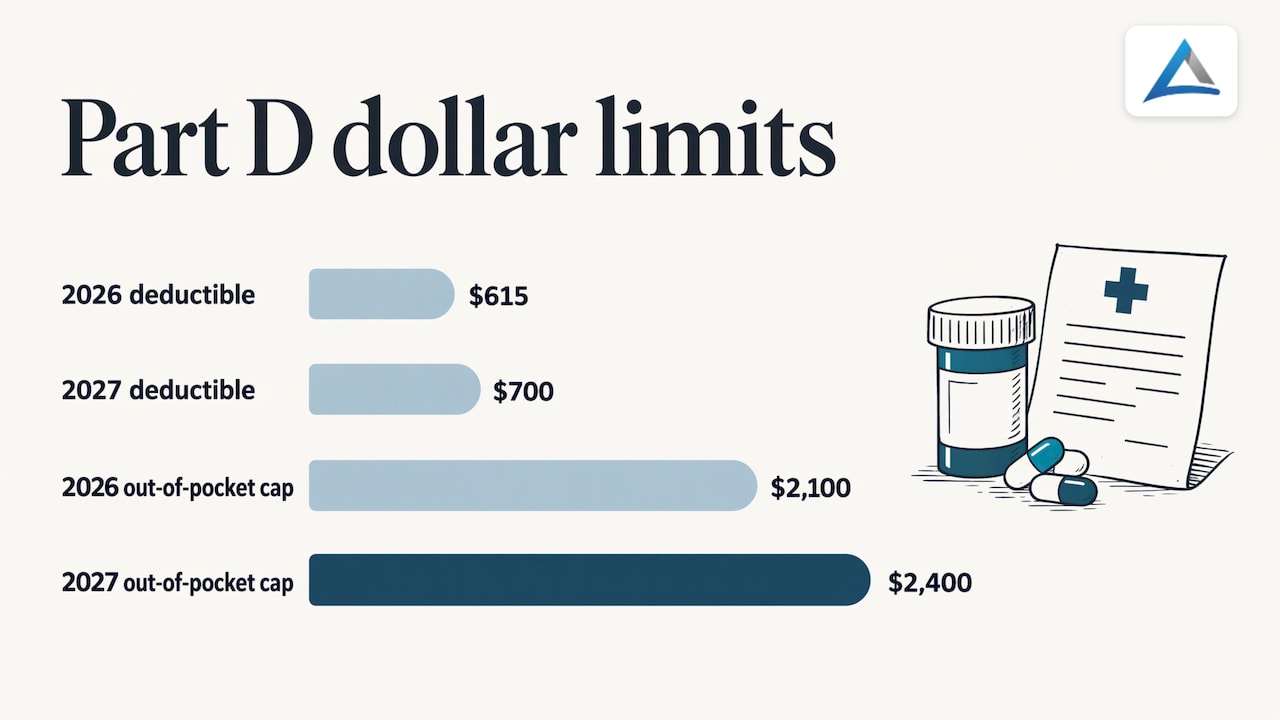
- In 2026, no Part D deductible can exceed $615, and your yearly out-of-pocket spending on covered drugs is capped at $2,100. Both figures rise in 2027.
Table of Contents
- What a Medicare drug formulary is
- The six protected classes
- How tiers set what you pay
- Rules that can apply to a covered drug
- How to check whether your drugs are covered
- If your drug is not covered or is restricted
- When a plan changes its list mid-year
- What you pay: 2026 and 2027 Part D figures
- Getting help with your drug list
- FAQ
- Sources
What a Medicare drug formulary is
Think of a formulary as the menu your plan orders from. Medicare explains that a plan’s list can include brand-name drugs, generic drugs, original biological products and biosimilars (close, lower-cost versions of biological drugs). Each list must include at least two drugs in the most commonly prescribed categories and classes, but the plan decides which ones.
You will see the same idea under other names: drug list, list of covered drugs, or “preferred drug list.” HealthCare.gov’s glossary uses “formulary” and “drug list” for the same thing. If you searched for a Medicare prescription drug list, this is it.
Why it matters: a plan negotiates lower prices on the drugs it lists. A CMS fact sheet explains that using a drug that is not on the list means paying full price rather than a copayment or coinsurance, unless you qualify for an exception.
Formulary and non-formulary drugs
A formulary drug is on your plan’s list. A non-formulary drug is not. If your prescription is off the list, CMS says you pay for it out of pocket unless you get an exception, and you can talk to your prescriber about covered alternatives.
The six protected classes
Plans have freedom, but not unlimited freedom. Medicare requires all Part D plans to include most drugs in six protected classes:
- Cancer drugs
- HIV/AIDS drugs
- Antidepressants
- Antipsychotics
- Anticonvulsants (seizure medications)
- Immunosuppressants for organ transplants
“Most drugs” is the important phrase. It does not mean every single product and strength, so you still need to check your specific medication. If you take a medication for depression or anxiety, it can also help to look at comparing Aetna and Cigna mental health coverage to see how differently insurers can approach behavioral health care.
How tiers set what you pay
Most formularies sort drugs into tiers. Medicare notes that plans divide tiers differently, but in general drugs in lower tiers cost less than drugs in higher tiers. A typical layout runs from Tier 1, with the lowest copayment and mostly generics, up to a specialty tier with the highest cost-sharing for very expensive drugs. Some plans use five tiers and some use six, so never assume the tier numbers mean the same thing from one plan to the next.
This gives you a practical way to shop. Medicare advises that if you take many generics, you should look for plans whose tiers charge no copayment or a low one for generics. If you take a specialty drug, the specialty tier and any coinsurance attached to it will matter more than the premium.
A worked example
Say you take three medications: a generic blood pressure pill, a generic cholesterol drug and one brand-name inhaler.
- Plan A lists both generics on Tier 1 and the inhaler on Tier 3.
- Plan B lists the generics on Tier 2 and does not cover the inhaler at all.
- Plan B may have the lower premium, but if you must pay full price for the inhaler, it is the more expensive plan for you.
The premium is one number. The tier, restrictions and pharmacy for each of your drugs decide the real cost. That is why the comparison has to start with your medication list, not with the plan’s monthly premium.
Rules that can apply to a covered drug
Being on the list does not always mean easy coverage. Medicare’s drug coverage guide describes three common rules:
- Prior authorization: the plan must approve the drug before it will pay, sometimes only for certain approved conditions.
- Step therapy: you first try a less expensive drug that is proven effective for your condition before the plan covers a more expensive one.
- Quantity limits: the plan covers only a set amount, for example 30 tablets per month, for safety and cost reasons.
The same guide describes safety checks, such as limiting a first opioid prescription to a 7-day supply or less. It also notes that when your coverage begins, you may get a one-time 30-day transition fill of a drug your plan does not cover or that needs prior authorization or step therapy. That fill buys you time to sort things out with your prescriber, not a permanent solution.
If you want the full picture on approvals, our guide to Medicare prior authorization walks through how it works.
How to check whether your drugs are covered
Here is the routine, step by step, and where each step tends to go wrong.
1. Write down every medication
List the name, the dose and how often you take it. New York State’s Department of Health advises writing down all three, because a plan may cover one strength differently from another. People often forget inhalers, eye drops, insulin and anything they take only occasionally.
2. Run the list through Medicare’s Plan Finder
The federal Medicare Plan Finder at medicare.gov/plan-compare lets you enter your medications and see detailed cost information for each drug across stand-alone drug plans and Medicare Advantage plans with drug coverage. It also shows participating pharmacies and Star Ratings from 1 to 5. The common mistake is entering only the drugs you take daily, or picking the wrong pharmacy, which changes the price.
3. Read the plan’s own drug list
CMS says to visit your plan’s website to see whether a prescription is on the list and what it costs. Look at the tier, and look for notes about prior authorization, step therapy or quantity limits. Plan Finder is a good start, but the plan’s formulary is the document that governs.
4. Ask your prescriber about alternatives
If your drug is restricted or costly, a covered alternative in the same class may exist. Your prescriber is the one to decide whether a switch is appropriate for you. Do not change or stop a medication on your own.
5. Repeat every year
Plans change. CMS reminds beneficiaries that drug lists are updated regularly and that if a change affects your care, you can consider switching plans or talk to your provider about switching drugs.
We do this comparison with you as part of our Medicare plan comparison help, so you are not left running a dozen searches on your own.
If your drug is not covered or is restricted
You have options. Medicare says you or your prescriber can ask for an exception to cover a drug that is not on the list, waive a coverage rule such as a quantity limit, or get a drug at a lower cost tier. Your prescriber supplies a supporting medical statement.
Timelines matter. According to New York State’s Department of Health, the plan generally has 72 hours to decide, or 24 hours for an expedited request, which only your prescriber can make. If the plan says no, you can appeal.
The formal name for this request under Part D is a coverage determination. A University of Connecticut pharmacy guide lists the types: quantity limit exception, step therapy exception, prior authorization, tier exception and non-formulary exception. It notes that a tier exception is not available for specialty drugs or non-formulary drugs, and that only you, an appointed representative, your prescriber or the prescriber’s staff can make the request. Knowing which type applies helps you and your pharmacist choose the right next move after a rejected claim.
When a plan changes its list mid-year
A formulary is not frozen. Under Medicare’s guide, a plan may remove a drug immediately if the FDA considers it unsafe or the manufacturer pulls it from the market. For other mid-year changes that affect a drug you take, the plan must give written notice at least 30 days ahead, or give notice at your refill along with at least a month’s supply.
There is also a yearly notice. New York State’s HIICAP training module explains that Part D members should receive a combined Annual Notice of Change and Evidence of Coverage by September 30, detailing next year’s premiums, costs, restrictions and formulary changes. Open it. It is the single best early warning that your drug is moving to a higher tier or gaining a restriction. Our post on Medicare coverage changes for 2027 covers what to check.
What you pay: 2026 and 2027 Part D figures
The drug list sets the tier. Federal rules set the outer limits on cost. Medicare’s cost page states:
| 2026 | 2027 | |
|---|---|---|
| Maximum plan deductible | $615 | $700 |
| Coinsurance after deductible | 25% | 25% |
| Out-of-pocket cap on covered Part D drugs | $2,100 | $2,400 |
Some plans have no deductible at all. Once your spending on covered drugs reaches the cap, you get catastrophic coverage with no out-of-pocket costs for the rest of the calendar year. The old coverage gap, or “donut hole,” is gone: CMS confirms that eliminating the initial coverage limit beginning in 2025 means you move straight from initial coverage to catastrophic coverage at the annual threshold.
The same rule says negotiated prices for the first group of selected drugs took effect on January 1, 2026. Those prices apply to specific drugs, so whether your medication is one of them is something to confirm when you review your list.
These limits apply to covered drugs. A non-formulary drug that is not covered does not count the same way, which is another reason the list matters. For a broader look, see our guides to Medicare Part D costs and formularies and Medicare costs in 2026.
Getting help with your drug list
Checking a drug list is straightforward when you take one medication. It gets harder with six, a specialty drug, or a spouse on a different plan. At Almond Insurance, a Medicare agency in Rockford, Illinois, we compare Medicare Advantage, Medicare Supplement and Part D plans for people in Northern Illinois and Southern Wisconsin, and we review your coverage every year. Our approach is plain language and patient, step-by-step education. We are paid by the insurance carriers when you enroll in a plan, so you do not pay us directly for the guidance.
Bring your medication list and we will go through it with you, plan by plan, through our Part D prescription review. If you are new to Medicare, our new-to-Medicare guidance starts with the timing and the choices in front of you.

Caregivers are welcome too. You can gather a parent’s medication list and walk through it with us, even before any decision about enrolling. You can also read about our Part D prescription drug plans, or when you are ready, see your next steps for enrolling.
FAQ
What is the difference between a formulary and a Part D plan?
The formulary is the list of drugs a plan covers. The Part D plan is the insurance that uses that list and sets your premium, deductible and tier costs. Two plans can have different formularies, so the list is one of the main things that sets them apart.
Can my plan drop a drug I already take?
Yes, though there are notice rules. A plan can remove a drug right away if the FDA considers it unsafe or the manufacturer takes it off the market. For other mid-year changes, you should get written notice at least 30 days ahead, or notice with a month’s supply at refill. Ask your prescriber about alternatives and request an exception if you need to stay on the drug.
Is a formulary the same as a prescription drug list?
Yes. Formulary, drug list and list of covered drugs all describe the same document. Each plan publishes its own, and it is divided into tiers that tell you what you pay.
How often should I review my plan’s drug list?
At least once a year, when your Annual Notice of Change arrives in the fall, and any time you start a new medication. Plans update their lists regularly, so a plan that covered your drugs well last year may not do so this year. Our Medicare enrollment timeline shows when each decision window usually falls.
Sources
- How do drug plans work? | Medicare
- Formulary - Glossary | HealthCare.gov
- How Medicare plans use pharmacies, formularies, and common coverage rules (CMS)
- Tips for Understanding Your Drug Coverage & Prescriptions (CMS)
- Your Guide to Medicare Drug Coverage
- Medicare Part D Frequently Asked Questions (New York State Department of Health)
- All Prior Authorizations are Not Created Equal (UConn School of Pharmacy)
- Module 6: Medicare Prescription Drug Coverage, Part D (NY State HIICAP, 2026)
- How much does Medicare drug coverage cost? | Medicare
- Medicare Program; Contract Year 2027 policy and technical changes (Federal Register, April 6, 2026)